Soochow University
 Chinese
ACS Nano - Multi-pronged ight-triggered nanoparticles
Multi-Pronged Design of Light-Triggered Nanoparticles to Overcome Cisplatin Resistance for Efficient Ablation of Resistant Tumor
Yanli Li, Yibin Deng, Xin Tian, Hengte Ke,* Miao Guo, Aijun Zhu, Tao Yang, Zhengqing Guo, Zhishen Ge, Xiangliang Yang, Huabing Chen*
ACS Nano, 2015, 9, 9626-9637
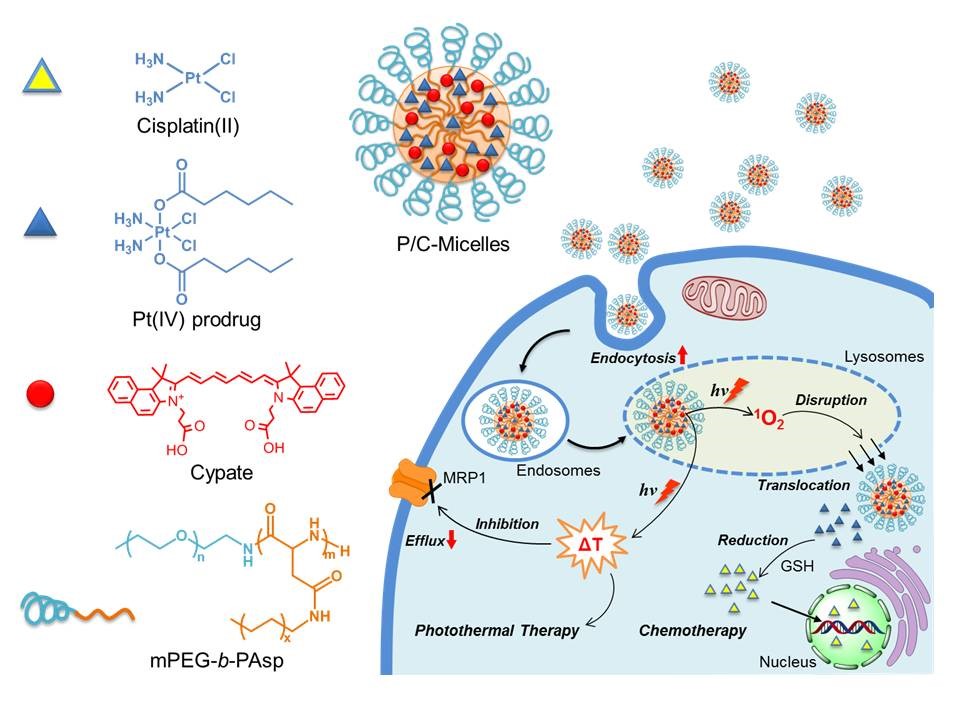
Abstract: Chemotherapeutic drugs frequently encounter multiple drug resistance in the field of cancer therapy. The strategy has been explored with limited success for the ablation of drug-resistant tumor via intravenous administration. In this work, the rationally designed light-triggered nanoparticles with multi-pronged physicochemical and biological features are developed to overcome cisplatin resistance via the assembly of Pt(IV) prodrug and cyanine dye (Cypate) within the copolymer for efficient ablation of cisplatin-resistant tumor. The micelles exhibit good photostability, sustained release, preferable tumor accumulation, and enhanced cellular uptake with reduced efflux on both A549 cells and resistant A549R cells. Moreover, near-infrared light not only triggers the photothermal effect of the micelles for remarkable photothermal cytotoxicity, but also leads to the intracellular translocation of the micelles and reduction-activable Pt(IV) prodrug into cytoplasm through the lysosomal disruption, as well as the remarkable inhibition on the expression of a drug-efflux transporter, multidrug resistance-associated protein 1 (MRP1) for further reversal of drug resistance of A549R cells. Consequently, the multi-pronged effects of light-triggered micelles cause synergistic cyototxicity against both A549 cells and A549R cells, and thus efficient ablation of cisplatin-resistant tumor without re-growth. The multi-pronged features of light-triggered micelles represent a versatile synergistic approach for the ablation of resistant tumor in the field of cancer therapy.